Parents ask this question all the time:
What’s the difference between childcare and preschool?
Usually, though, that is not the question they are really asking.
What they are really trying to figure out is:
Will childcare prepare my child for school?
Will my child be ready for kindergarten? Will they learn enough? Should I move them into a “real preschool” once they are old enough?
The answer is more complicated than simply saying childcare is for supervision and preschool is for learning.
In a high-quality early childhood program, those things should not be separate.
Childcare Can Include Preschool
At Green Garden, we think about childcare and preschool as part of the same early childhood continuum.
For younger children, families may be enrolled in a tuition-based childcare program.
As children get older, they may transition into a preschool program such as Michigan’s free GSRP preschool.
The funding structure may change. The hours may change. The classroom may change.
But learning did not suddenly begin when the child entered preschool.
Children have been learning the entire time.
A toddler negotiating over a toy is learning.
A three-year-old figuring out how to join a group of children playing is learning.
A child climbing something difficult, falling, adjusting their strategy, and trying again is learning.
A child telling a teacher, “I need help,” is learning.
Early childhood education is happening long before anyone hands a child a worksheet.
Kindergarten Readiness Is Bigger Than Letters and Numbers
One of the biggest misunderstandings about preschool is that kindergarten readiness means getting children academically ahead.
Parents naturally want their children prepared.
But preparation does not mean rushing children into the next developmental stage.
We are not trying to turn preschool into kindergarten early.
We are trying to fully develop the stage children are in right now.
Young children need to play.
They need to move their bodies.
They need to connect with other people.
They need to experience frustration.
They need to fail at things.
They need to try again.
They need to solve problems that actually matter to them.
Those experiences build the skills children will rely on when academics become more demanding later.
The Skills We Care About Most
Of course we want children exposed to language, literacy, numbers, science, art, and other academic concepts.
But some of the most important kindergarten-readiness skills are much harder to measure on a worksheet.
Can a child ask for help?
Can they ask for a turn?
Can they hear “no” without completely falling apart?
Can they recover when something does not work?
Can they try again?
Can they be kind and thoughtful toward other people without believing they always have to give up their own wants and needs?
Can they advocate for themselves?
Can they navigate being one person inside a group of other people?
Those are sophisticated skills.
And children do not learn them by memorizing answers.
They learn them by living them.
Why Play Matters
Young children learn with their whole bodies.
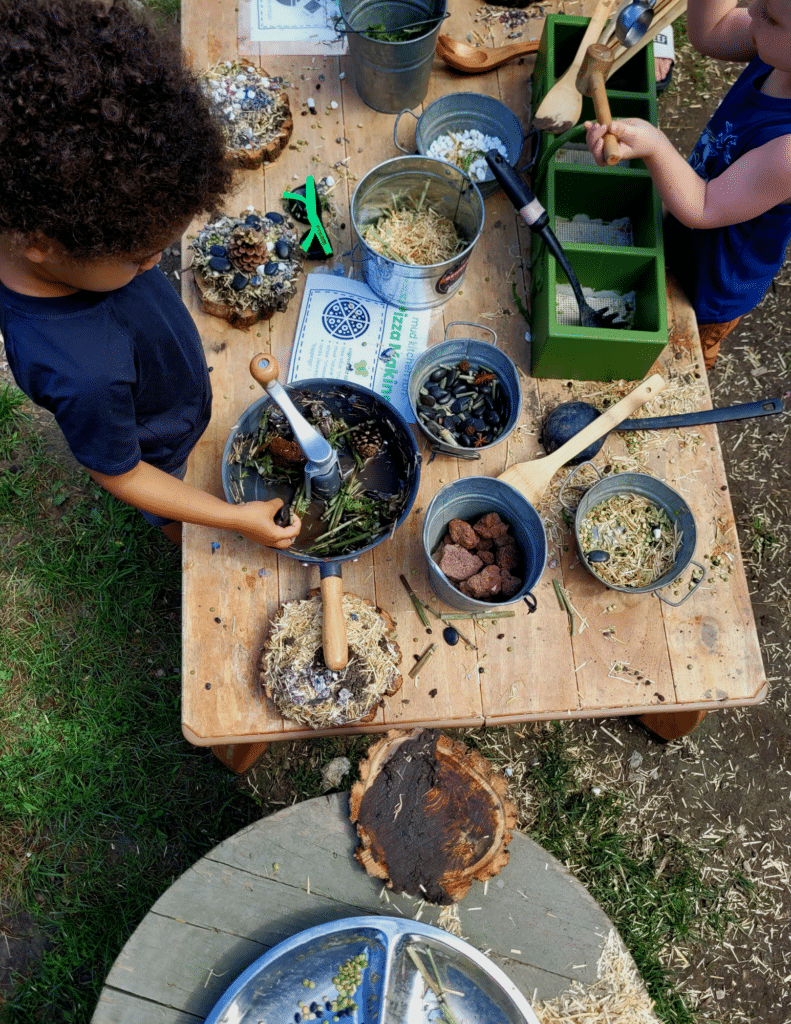
They build understanding by touching, moving, testing, pretending, building, climbing, talking, observing, repeating, and experimenting.
That is why we are cautious about preschool environments that become overly academic too early.
Worksheets can show whether a child remembers an answer.
They cannot teach a child how to negotiate with a friend.
They cannot teach persistence when a block tower keeps falling.
They cannot teach a child how to enter an already-established game on the playground.
They cannot recreate the emotional experience of hearing “not right now,” managing disappointment, and deciding what to do next.
Those lessons happen through real experiences.
That is the work of early childhood.
“Daycare” and “Preschool” Are Not Quality Ratings
The words themselves can also be misleading.
A program can call itself a preschool and still offer a weak early childhood experience.
A childcare center can provide deeply intentional, developmentally appropriate education throughout the entire day.
The label does not tell you enough.
Quality does.
That is why families should look beyond the name on the building.
At Green Garden, most of our schools have earned five-star quality ratings, with the others rated at four stars. But even ratings are only one piece of what families should evaluate.
When you walk into an early childhood program, look at what is actually happening.
What Parents Should Look for When Touring a Program
First, look for connection.
Watch how teachers talk to children.
Do they seem to genuinely know them?
Do children seek them out?
Are teachers down at children’s level, engaged in what is happening, or mainly directing the room from a distance?
Then watch how teachers handle difficult moments.
A preschool classroom will not be perfectly quiet, organized, or conflict-free.
It should not be.
Young children are learning how to function together.
The question is how adults respond when something goes wrong.
Do teachers solve every problem for children?
Do they immediately punish?
Or do they help children think, communicate, and work through the situation?
Also look for care and attention to detail.
You can often feel when a classroom has been thoughtfully designed for children.
Materials are accessible.
Children’s work and ideas are visible.
The environment invites exploration.
Teachers understand why materials are there and how children might use them.
That level of intentionality matters.
What High-Quality Preschool Inside Childcare Can Look Like
For families, the practical distinction between childcare and preschool is sometimes much less dramatic than they expect.
At Green Garden, our tuition-based programs are open from 7:00 a.m. to 6:00 p.m., and enrolled children can attend up to 10 hours during that window.
Once eligible children enter our free GSRP preschool program, their preschool day runs from 8:30 a.m. to 3:30 p.m.
Families who still need a longer day can use wraparound care, extending their schedule from 7:00 a.m. until 5:30 p.m.
So the question is not necessarily:
“Do I need childcare or preschool?”
A better question might be:
What kind of early childhood program does my child need, and what schedule does our family need?
We Are Not Trying to Create a Watered-Down Elementary School
One thing we say often at Green Garden is:
We do not want to be a watered-down version of school. We want to be an extension of home.
That does not mean children are not learning.
It means we respect how young children actually learn.
Home is where children first learn how relationships work.
They learn how to communicate needs.
They learn what happens when something goes wrong.
They learn to trust adults.
They develop independence.
They explore.
They imitate.
They experiment.
They build a sense of who they are.
A strong early childhood program should extend that development while giving children something home cannot fully recreate: a community of peers, trained teachers, carefully designed environments, and hundreds of small opportunities to practice being part of a larger world.
So, What Is the Difference Between Childcare and Preschool?
The simplest answer is this:
Preschool can exist inside childcare.
Childcare describes a broader system of care for young children, often beginning in infancy and continuing until school age.
Preschool generally refers to the educational experience provided during the years before kindergarten.
But in a high-quality program, education does not suddenly begin at age four.
Learning has been happening all along.
The more important distinction is not childcare versus preschool.
It is high-quality early childhood education versus a program that is simply supervising children.
And if your goal is kindergarten readiness, do not only ask whether your child will learn letters, numbers, or how to sit still.
Ask whether they are learning how to think.
How to communicate.
How to solve problems.
How to recover.
How to connect.
How to advocate for themselves.
How to try again.
Those are the skills that prepare children not just for kindergarten, but for everything that comes after it
If you’re comparing childcare and preschool in Metro Detroit,
come see what early learning looks like when children are allowed to learn the way
young children actually learn.
Explore our Green Garden locations or schedule a tour.
.
Be the first to write a comment.
Your feedback
You must be logged in to post a comment.